Contemporary Wall Lights – Modern Sconces & Wall Lamps
Did you know that contemporary wall lights can transform your space significantly? A single sconce can reframe a piece of art or widen a narrow hallway. In fact, if you want to add finishing details that will turn your room from incomplete to intentional, you can go with contemporary wall lights.
Why? Well, unlike overhead fixtures that provide general illumination, wall lighting operates closer to the human scale.
In simple words, it interacts with and complements the texture, the color, and the rhythm of architecture more comprehensively to give you a personalized feel. With a well-placed wall light, you can shape how a space feels at every hour. For instance, it can be soft, sculptural, intimate, or even expansive.
In this guide, we will explore how to select and apply contemporary wall sconces effectively. Moreover, we will discuss how to cover definitions and the details you should know about:
- Lighting Layers
- Technical Considerations
- Room-by-Room Applications
- Emerging Trends
- Common Design Mistakes to Avoid
Keep reading to make sure that when you go for contemporary wall lights, whether it’s a bedroom sconce or living room wall light, it’s the perfect match to your interior design needs and personality.
What Defines “Contemporary” in Wall Lighting

The word “contemporary” in lighting doesn’t always mean trending or “what’s trending now.” In fact, it’s much closer to “of the moment”, which means that the lights are not one-size-fits-all but rather more personalized and adaptive to the latest style variations.
For instance, modern wall sconces are great at embracing simplicity and craftsmanship. In addition, the latest designs and innovative ideas bring integrated technology into the mix without decorative excess.
In fact, here are the key characteristics:
- Clean lines and balanced proportions – Contemporary fixtures avoid unnecessary ornamentation. Their elegance comes from geometry, restraint, and scale.
- Geometric or organic forms – Whether linear, sculptural, or softly curved, modern sconces rely on shape and shadow rather than surface embellishment.
- Mixed materials – Designers often blend glass, brass, ceramic, or stone to achieve warmth and contrast. Textural combinations add dimension without clutter.
- Integrated technology – LED modules, precision drivers, and smart controls are discreetly embedded to offer efficiency and long-term performance.
- Sustainability and repairability – Contemporary wall lights are designed to last because modular components, serviceable LEDs, and durable finishes support longevity.
However, this approach contrasts sharply with traditional wall sconces that rely on ornate flourishes or historical motifs. The modern wall lamp can become a part of your architecture, and also be a sculptural feature to support both light and atmosphere.
An Overview of Functional Roles and Lighting Layers

Now that we understand that wall sconces are integral to layered lighting design, here’s when to use them strategically (i.e., for balancing ceiling fixtures, floor lamps, and natural light for better comfort and harmony:
Ambient, Task, and Accent Roles
- Ambient lighting: Wall sconces can serve as part of a room’s general illumination by bouncing light off walls and ceilings. Uplighters soften the edges of a room, while translucent diffusers create a gentle halo that reduces dependence on overhead lights.
- Task lighting: Adjustable or directional sconces, especially swing-arm designs, deliver practical light for reading, grooming, or entryway routines. They save valuable surface space in compact areas like bedrooms or offices.
- Accent lighting: Contemporary wall lamps excel at highlighting art, architectural features, or textured walls. Narrow-beam fixtures add contrast, making a room feel layered and dimensional.
Directionality: Up, Down, or Both
- Uplight: Expands perceived height, ideal for low ceilings or mood-driven zones like living rooms.
- Downlight: Focuses illumination downward for reading or highlighting surfaces such as sideboards and art panels.
- Dual-beam: Combines both directions for balance, excellent in lounges, corridors, and entryways where ambiance and visibility intersect.
Dimming and Controls
You should note that modern wall lights are more effective when used flexibly. As an example, dimmable systems (like TRIAC, ELV, 0–10V, or DALI) let designers adjust brightness across different moods.
On the other hand, going for smart-enabled sconces allows you to integrate with app controls or voice assistants (for effortless scene-setting). But make sure to check dimmer compatibility before purchase and confirm that LED drivers remain accessible for maintenance.
Key Design and Technical Considerations

Moving forward, your purchase for contemporary wall lights, whether as bedroom hanging light additions or living room sconces for better aesthetics, will require you to consider multiple factors.
Size, Scale, and Profile
Since scale will determine the relevance and proportion of the fixture against the overall architecture, you have to be thoughtful here. A fixture that’s too small disappears, while one that’s oversized overwhelms.
So, for most interiors:
- Match fixture scale to adjacent furniture height and wall width
- In open-plan layouts, opt for deeper projections that hold their visual weight
- In narrow spaces, prefer low-profile sconces that sit closer to the wall
It’s always recommended to mock up dimensions with painter’s tape or paper cutouts to preview how the light reads at eye level.
Mounting Height and Spacing
Here are some of the most helpful general guidelines:
- Living rooms and hallways: center fixture around 152–170 cm (60–67 in) above the finished floor.
- Bedside sconces: mount roughly 100–120 cm (39–47 in) above the mattress top, ensuring the light cone meets the reading plane.
- Corridors: space fixtures about 2.5–3 meters apart (8–10 ft) for a consistent rhythm.
Still, you can adjust for architectural conditions because higher ceilings can support slightly elevated placements. Furthermore, here’s what to quickly note about bulb type, color temperature, and color rendering index (CRI):
- LEDs dominate for efficiency and lifespan
- Color temperature:
- 2700K–3000K: warm, inviting glow ideal for bedrooms and living spaces
- 3000K–3500K: slightly cooler light suitable for offices or bathrooms
- CRI (Color Rendering Index): 90+ ensures accurate color and texture representation
- Energy efficiency: you want to prioritize integrated or replaceable LED modules to minimize waste
What to Do for Installation – Flush vs. Projecting
Flush-mounted sconces keep walls clean and are best for hallways and tight spaces. On the other hand, projecting sconces create sculptural depth but require adequate clearance.
If rewiring isn’t possible for existing walls, go with plug-in sconces for better retrofit elegance. However, if you want a tidy look, go for concealed cords with cable channels or wall paint.
How to Manage Glare and Shadow
A hallmark of quality design is comfort. For that, you can go for frosted glass, alabaster diffusers, or indirect optics to soften shadows and prevent harsh contrast. But for textured walls, angle the light to reveal depth without producing visual hotspots.
Room-by-Room Applications and Styling Tips

Here’s a little more on how you can make sure the contemporary wall lights complement every space, every room you install them in. Make sure you adjust every light to the best of its features to complement the room
Bedroom Sconces and Wall Lamps
Bedside sconces are both practical and luxurious. They save tabletop space, reduce clutter, and provide individualized control for reading or relaxation.
- Choose swing-arm sconces for flexibility; they allow focused task light without disturbing a partner.
- For a soft ambient look, diffused alabaster or glass sconces cast a restful glow across headboards and fabrics.
- Combine with a small table lamp or ceiling pendant for layered, hotel-quality comfort.
Keep light sources warm (2700K) and ensure switches are easily reachable from bed.
Living Room and Lounge Wall Lights
Living rooms thrive on sculptural lighting that defines architecture.
- Flank a fireplace or artwork with symmetrical sconces to anchor focal points.
- For a media wall, use indirect or up-down sconces that enhance atmosphere without screen reflection.
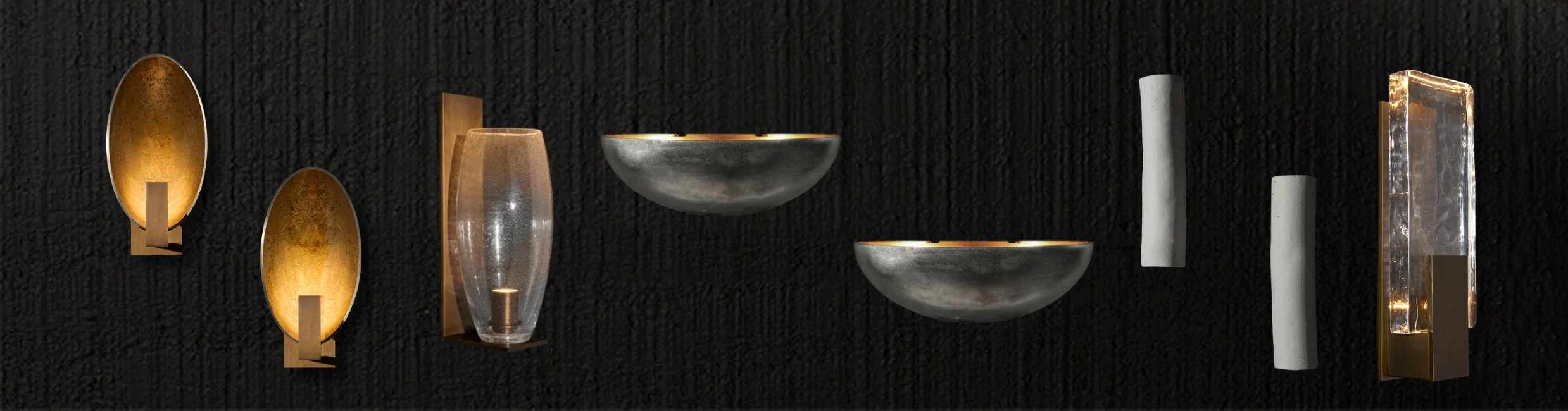
- Sculptural or statement sconces double as art when unlit, especially those crafted from brass, marble, or blown glass.
You can layer wall lights with pendant fixtures or table lamps to transition from bright afternoon to relaxed evening ambiance.
Hallways, Entrances, and Transitional Spaces
Since corridors often lack daylight and depth, you can correct this by using wall lights that spread even illumination across vertical surfaces.
- Mount sconces approximately 30 cm (12 in) from the wall to achieve a gentle wash of light
- Repeat fixtures along the corridor at consistent intervals for rhythm and wayfinding
- In entryways, use a signature sculptural sconce to make a memorable first impression
Are There Specialized Use Cases?
We understand that there can be distinct requirements when it comes to lighting because everyone has a unique personality and a way to demonstrate it – not to mention everyone has varying functional needs. So, here’s what to do in the following special use cases:
- Bathrooms: For vanity mirrors, install a pair of sconces at face level (about 150 cm from the floor) and 25–30 cm apart from the mirror edge for shadow-free illumination. Use IP-rated fixtures suitable for damp areas.
- Reading nooks: Compact, directional sconces with pivoting heads are perfect for small alcoves or window seats.
- Galleries or art walls: Picture lights or narrow-beam sconces highlight texture and form. Maintain recommended lux levels for art preservation, and use UV-filtered sources for sensitive materials.
- Rental or retrofit settings: Plug-in sconces are ideal, modern designs disguise cords elegantly and allow flexibility without renovation.
Trends and Innovations to Watch
1. Sculptural, Statement-Making Sconces
Designers now treat wall lights as functional art. Large-scale, asymmetric, or organically shaped fixtures serve as visual anchors, often replacing framed art altogether.
2. Smart and App-Enabled Wall Lights
Modern lighting integrates seamlessly with smart ecosystems. Wall sconces equipped with programmable dimming, circadian rhythm adjustments, or remote scheduling make personalization effortless.
3. Natural, Tactile Materials
Now, you can also expect to see more smoked glass, hand-carved stone, patinated metal, and ceramic finishes. These materials ground modern interiors with tactile honesty and more importantly, they age gracefully.
4. Custom and Artisanal Pieces
Bespoke sconces, tailored in size, color, and material, are increasingly sought after by designers. They align perfectly with RENG Lighting’s ethos of generational craftsmanship and material excellence.
5. Biophilic, Nature-Inspired Forms
Lighting designers draw inspiration from organic shapes: petal-like diffusers, branch silhouettes, and wave contours, as only a few of the latest examples. These designs connect interiors to nature’s rhythm while letting you maintain modern sophistication.
Common Mistakes and How to Avoid Them

1. Oversized or Undersized Fixtures
Scale is the most frequent misstep. It’s always a good idea to use mockups or visualizations to ensure sconces relate harmoniously to furniture and architecture.
2. Incorrect Mounting Height or Spacing
Mount too high, and you lose intimacy; too low, and the fixture intrudes into sightlines. So, always check proportions at eye level before installation.
3. Harsh Glare or Poor Bulb Selection
You want to avoid exposed bulbs near seating zones. Instead, go for frosted diffusers or lamps with integrated optics to soften contrast where necessary.
4. Overreliance on Wall Lights Alone
Many homeowners often forget that sconces should complement, not replace, other lighting. Therefore, always consider combining and transitioning, like with overhead and task source lighting to create adaptable moods.
5. Neglecting Wiring and Retrofit Planning
Lastly, make sure you’re in coordination with your electricians early. For existing walls, you want to plan surface conduit or retrofit systems for a cleaner aesthetic without costly demolition.
A Specification Checklist for You
Before finalizing any wall lighting plan, confirm these essentials:
- Define the fixture’s role: ambient, task, or accent.
- Confirm mounting height and spacing for each room type.
- Specify color temperature (2700K–3000K) and CRI 90+ for consistent color accuracy.
- Identify dimming protocol and driver accessibility.
- Check wall structure and junction box ratings for fixture weight.
- Choose between hardwired or plug-in versions depending on installation.
- Request finish samples and photometric data for approval.
- Coordinate delivery and lead times early, especially for artisanal or imported fixtures.
How Should I Consider Longevity and Sustainability?
Today, contemporary wall lights are increasingly becoming a long-term investment. For instance, artisanal sconces are crafted in small workshops using durable materials, age gracefully, and often remain serviceable for decades.
Furthermore, if you get lights with replaceable LED modules and modular components (as is often the case with modern options), it means that the fixture can evolve as technology does.
From a sustainability perspective, longevity reduces environmental impact far more effectively than recycling short-lived mass-market fixtures. Plus, you get to choose from materials like alabaster, brass, and glass, which, by the way, you can refinish, repolish, or reuse.
Conclusion
You can bring artistry and engineering into your space with contemporary wall lights. They illuminate spaces with emotion and enhance how you perceive texture, color, and proportion.
Whether framing a mirror, softening a hallway, or setting a tranquil mood beside a bed – you can take advantage of how wall sconces play a defining role in both residential and commercial interiors.
As a rule of thumb, start with proportion, placement, and performance. That way, you can create lighting that feels intentional (rather than incidental).
For deeper design inspiration, explore RENG Lighting’s curated wall, ceiling, and table lamp collections. You can now browse lookbooks and talk to the best professionals in the industry to get inspiration.
Schedule a Consultation to review fixtures in person at our showroom!